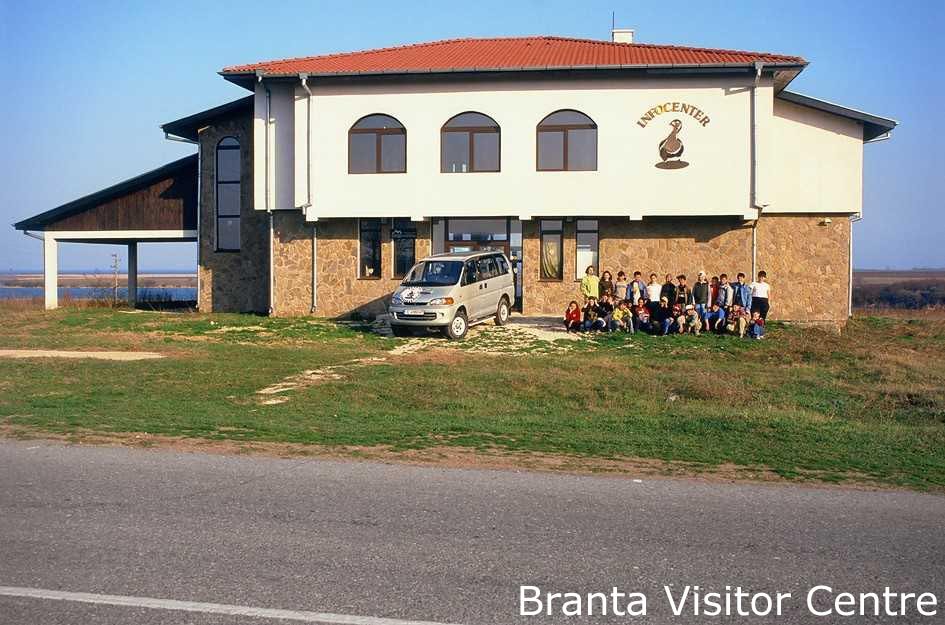
Spring Botany (and Birds)Day 1: Varna - Durankulak Flight to Varna. On arrival you will be met by a representative of BRANTA-TOURS. Transfer (50 miles) to Durankulak, on the north Black Sea coast, with a stop-off en route to visit one of the richest botanical gardens of the Balkans. Dinner and first of three nights at Branta Birding Lodge overlooking Durankulak Lake and Black Sea. Day 2: Kaliakra After breakfast, we set off to spend the day exploring Cape Kaliakra, and its surrounds. Set in the largest surviving area of virgin steppe in Bulgaria, Kaliakra is also an archaeological monument, the site of ancient dwellings and fortresses covering more than 2500 years of human occupation.
The 70-m high cliffs make an excellent vantage point for Dolphin watching, whilst the abrupt westward turn of the coast here results in concentrations of migrating birds.
We will spend the morning on the botanical reserve of Cape Kaliakra, the largest surviving expanse of steppe in Bulgaria. Frequent autumn and winter gales have helped determine the cape's highly specific flora. More than 600 plant species occur here, including - more notably - Adonis vernalis, Adonis volgensis, Paeonia tenuifolia, Potentilla mollicrinis, Potentilla bornmuelleri, Ruta graveolens, Stipa lessingiana, Artemisia pedemontana, Agropyrum brandzae, Asphodeline lutea, Iris pumila, Scutellaria orientalis, Salvia nutans, Salvia argentea, Salvia aethiops, Onosma taurica, Onosma arenaria, Onosma echioides, Nonnea atra, Ruta glaveolens, Euphorbia myrsinites, etc.
Kaliakra is rich in birds as well as plants and this is one of the best sites in Europe to see Rose-coloured Starlings. There, and at Boilata, where we will have lunch, you can also see breeding Pied Wheatear, Stone Curlew and Calandra Lark.
In the afternoon we will visit Cape Zelenka, where Mattiola odoratissima and Gypsophylla trichotoma can be seen.
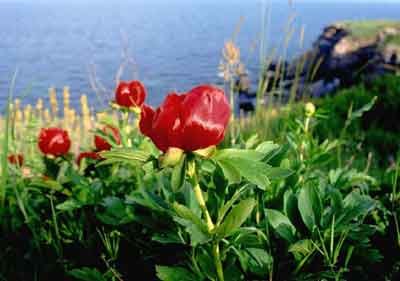
Return to our lodge for dinner. Day 3: Yailata After breakfast we drive 12 miles to Yailata, an archaeological site dating from Roman times. Here steppe and sea-cliff meet in a limestone landscape that holds some 350 plant species. The normally rare Peonia peregrina is common here. Also found here is the endemic and eponymous Silene caliacrae, as well as Iris pumilla, Adonis flammea, Asphodeline lutea, Alyssum borseanum, etc.
The sea-cliffs are rich in caves and this was one of the last refuges for the Monk Seal in the Black Sea.
After lunch we visit Roussalka and Tauk-liman, some of the most picturesque locations on the northern Black Sea coast and both of considerable botanical interest. We finish the day at Durankulak Lake - a Ramsar site of high ornithological interest, close to the Romanian border.
Return to the lodge for dinner.
Spring Botany (and Birds)Day 4: Durankulak - Bourgas After breakfast transfer (100 miles) to the southern Black Sea port of Bourgas.
We break the journey twice, firstly to explore the rocky landscape near Balchik, where we should see Mattiola odoratissima, Astragalus excapus, A.vesicarius, A.pubiflorus and Gypsophyla glomerata. Our second stop, in the Eastern Balkan Mountains, will show us some of the flora of the oak forests.
Dinner and first of two nights in hotel White House in neighbouring Pomorie. Day 5: Bourgas Saltpans Today we explore Lake Atanasovsko Reserve, one of Bulgaria's five RAMSAR sites. The 1690 ha. complex includes extensive saltpans, freshwater pools, marshes and areas of scrub and semi-steppe. The site's main interest is ornithological, but the highly specific conditions here make for a fascinating flora too.
Lake Atanasovsko's position on the east European Via Pontica migration flyway attracts a great variety of migrant birds in spring and autumn. More than 300 birds species have been recorded here.
We will be able to enjoy the spectacle of the lake's breeding birds, including some hundreds of Avocets, Black-winged Stilt, Collared Pratincole (Black-winged have been seen here too!), Kentish Plover, Gull-billed Tern, Mediterranean Gull, Little Tern, Marsh Harrier and Penduline Tit. Caspian Tern, Slender-billed Gull and Squacco Heron are also seen at this season, and we may turn up Marsh Sandpiper. Cetti's Warbler and Little Bittern breed in the reedbeds, and Black-headed Buntings and Red-backed Shrikes are numerous on fields surrounding the lake.
The site's vegetation is typified by Salicornia herbacea, Salicornia europaea and Typha angustifolia, but includes two species endangered in Europe: Coryspermum nitidum and Lepidotrichum uechtritzianum.
For dinner we sample traditional Bulgarian cuisine in a folk-tavern in the historic town of Nessebar. Return to Pomorie. Day 6: Bourgas - Strandja Nature Park After breakfast, transfer (40 miles) south to the Strandja Nature Park, visiting en route the reserves of Ropotamo, Arkutino and Alepu. At Ropotamo we will explore a primary alluvial forest of Quercus pedunculiflora, Ulmus laevis and Alnus glutinosa with Smilax exelsa and Peiploca graeca. The psammophytic vegetation near Arkutino includes Lepidotrichum nechtritzianum, Anchusa velenovskyi, Linum tauricum bulgaricum, Pancratium maritimum Silene euxina, Hypecoum ponticum, Jurinea albicaulis kilaea, Stachys maritima, Medicago marina, Eryngium maritimum, Euphorbia paralias, etc. Arkutino lake is famous for its abundance of Nymphaea alba. Generally in the area we can expect to find Tulipa hageri, Scilla bythinica, Fritillaria pontica, Heptaptera triquetra, Ruscus aculeatus, Symphytum tauricum, Iris suaveolens, etc. Several orchid species are found here too, including Anacamptis pyramidalis, Orchis purpurea, Orchis ustulata and Limodorum abortivum.
Dinner in the historic town of Sozopol (on the south Black Sea coast) and first of 3 nights at a beautiful local guesthouse.
Spring Botany (and Birds)Day 7: Strandja / Veleka After breakfast we set off to explore the mouth and the lower stretches of the river Veleka and the Silistar protected area. This will take us into the coastal section of Strandja Nature Park, close to the Turkish border.
Here the vegetation is predominantly psammophytic with species like Otauthus maritimus, Pancratium maritimum, Calystegia soldanella, Euphorbia paralias etc.
The coastal vegetation is characterised by Cistus incanus, Cistus salvifolius, Serapias vomeraceae, Orchis papilionaceae, Scorpiurus subvillosus, Hymenocarpus circinalis, Iris sintenisii, Geranium asphodeloides, Geranium sanguineum, Silene copmacta etc.
The oak woods - the dominant habitats encountered in the Strandja complex - comprise primarily Quercus polycarpa, Q. frainetto and Q. hartwissiana. Herbaceous species here include Cyclamen coum, Primula sibthorpii, Fritillaria pontica, Celsia bugilifolia, Heptaptera triquetra, Trachystemon orientale, Salvia forskaohei etc.
Return to our guesthouse for dinner. Day 8: Strandja : Silkosia Reserve Further exploration of the Strandja range, now in the botanical reserve of Silkosia. Here, forests of Eastern Beech (Fagus orientalis) hold a shrub floor of Rhododendron ponticum, Daphne pontica, Ilex colchica, Laurocerasus officinalis etc.
The oak groves are the home of: Hypericum calycinum, Pyracantha coccinea, Stachys thracica, Epimedium pubigerum.
Return for dinner and last night at our guesthouse. Day 9: Strandja - Kamchiya - Varna Drive back north, visiting an exceptional village-museum for a cultural diversion.
After lunch we will explore the Kamchiya Biosphere Reserve, with its remarkable alluvial or Longoz forest, one of the most northerly of its kind in Europe. The reserve complex, totaling about 1500 ha., includes dunes, beach, estuary and small freshwater pools. Dominant trees in the alluvial forests are Ulmus minor, Quercus pedunculiflora, Acer campestre, A.tatataricum and Ulmus leavis. In the dune area are found species as Silene euxina, Alyssum borsaeanum, Crambe maritima, Cardamine tuberosa (near the mouth of Kamchiya river) and Lepidotrichum uechtritzianum. The rare Nuphar lutea and Nymphaea alba grow on the marshy parts of the reserve.
In the evening we return to Kavarna and make a tour of the town before dinner. Final night at our hotel. Day 10: Varna Airport After breakfast transfer to the airport for your return flight. |

 4 Photos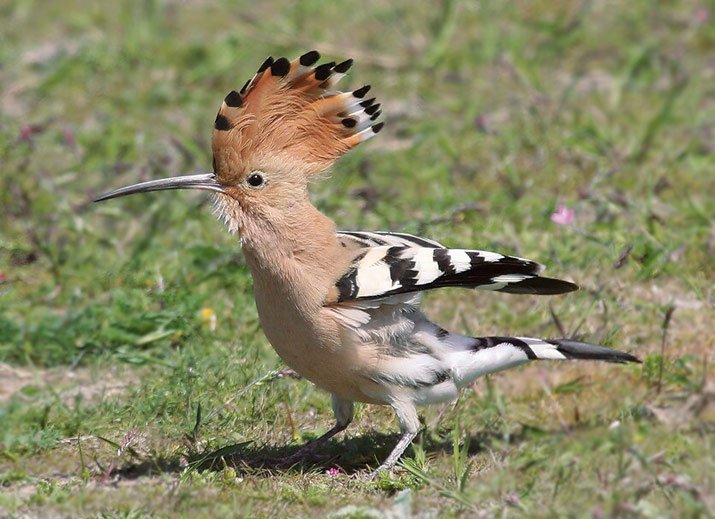
 Duration8 Days
 Group Size2-15 guests
 FocusBotany and birds
 BaseBulgaria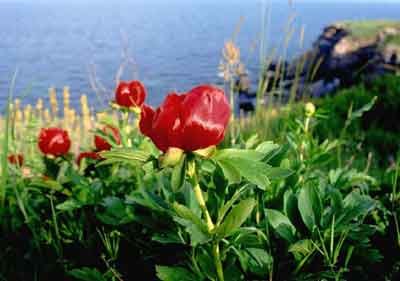
 Trip Type